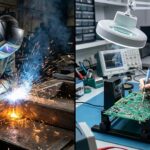
Arc welding is one of the most widely used metal joining processes in industries such as construction, automotive, aerospace, shipbuilding, and manufacturing. It uses electrical energy to generate intense heat that melts metal pieces and fuses them together into a strong and durable joint. Because of its versatility, cost-effectiveness, and ability to weld different metals, arc welding has become a preferred choice for both industrial fabrication and repair work.
Whether you are building heavy steel structures, repairing machinery, fabricating pipelines, or manufacturing vehicle components, arc welding plays a critical role in ensuring structural integrity and long-lasting performance. In this complete guide, you’ll learn what arc welding is, how it works, its working principle, equipment, types, applications, advantages, disadvantages, and important safety considerations in simple and practical language.
What is Arc Welding?
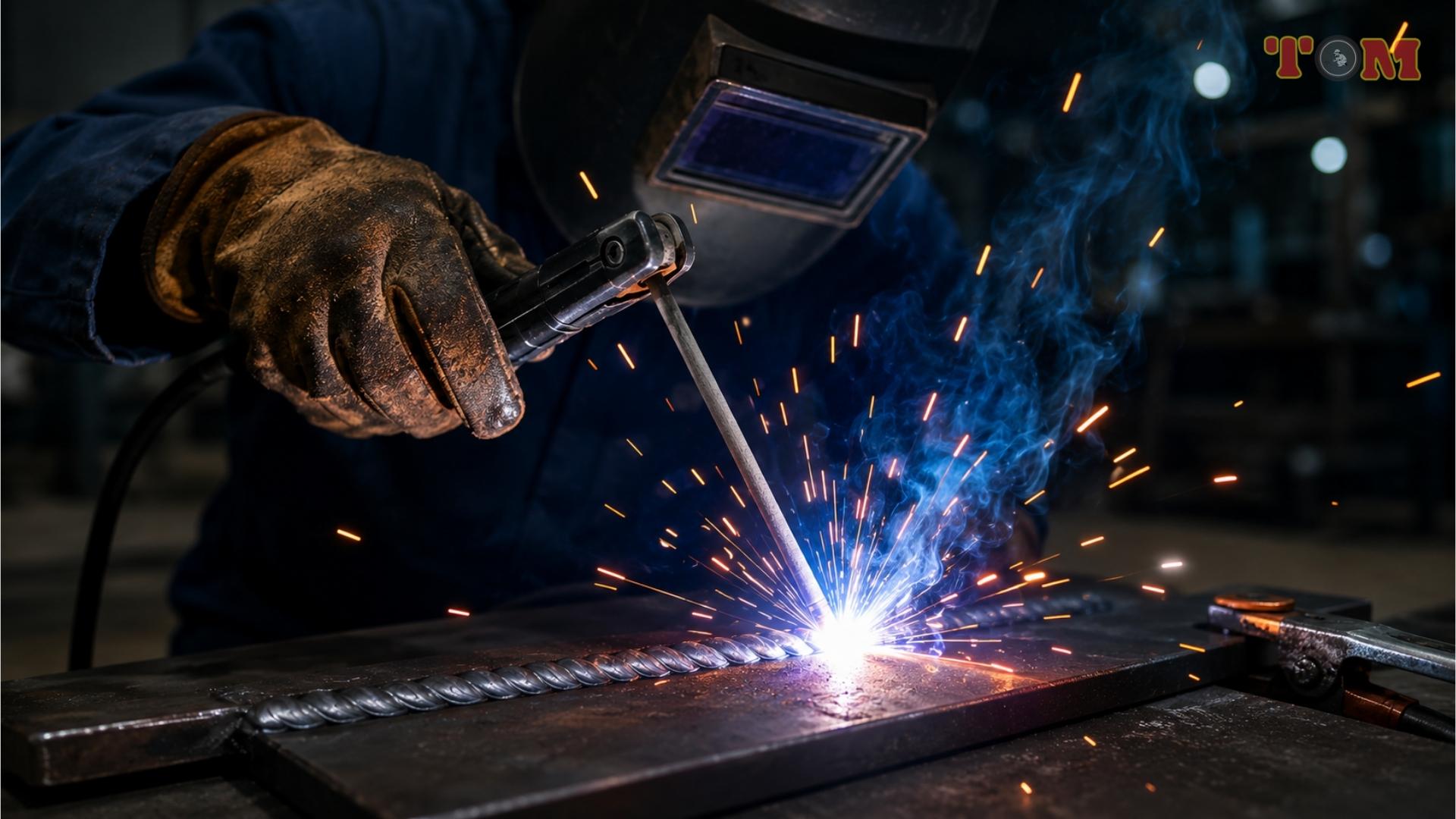
Arc welding is a welding process that joins metals by using an electric arc to generate heat. The arc forms between an electrode and the base metal, producing extremely high temperatures that melt the metal at the joint location. Once cooled, the molten metal solidifies and forms a strong bond.
The temperature of the electric arc can exceed 6,000°C, making it suitable for welding most engineering metals, including steel, stainless steel, aluminum, and cast iron. Depending on the process, the electrode may either melt and become part of the weld or remain unchanged.
Working Principle of Arc Welding
The working principle of arc welding is based on the generation of heat through an electric arc.
When electric current passes between the electrode and the workpiece, resistance creates an arc. This arc generates enough heat to melt the base metals and filler material. Once the molten pool cools and solidifies, a permanent welded joint is formed.
Three key principles make arc welding effective:
1. Electric Arc Formation
The electric arc forms when there is a small gap between the electrode and the metal surface. This arc generates extreme heat necessary for melting metal and creating fusion.
2. Electrode Function
The electrode carries electrical current to the welding point.
There are two types of electrodes:
Consumable Electrodes: Melt during welding and become part of the weld.
Non-Consumable Electrodes: Do not melt and are mainly used in TIG welding.
3. Shielding Protection
Molten metal reacts quickly with oxygen, nitrogen, and moisture from the atmosphere. Shielding prevents contamination and weld defects.
Shielding can be achieved using:
Flux-coated electrodes
Shielding gases
Granular flux materials
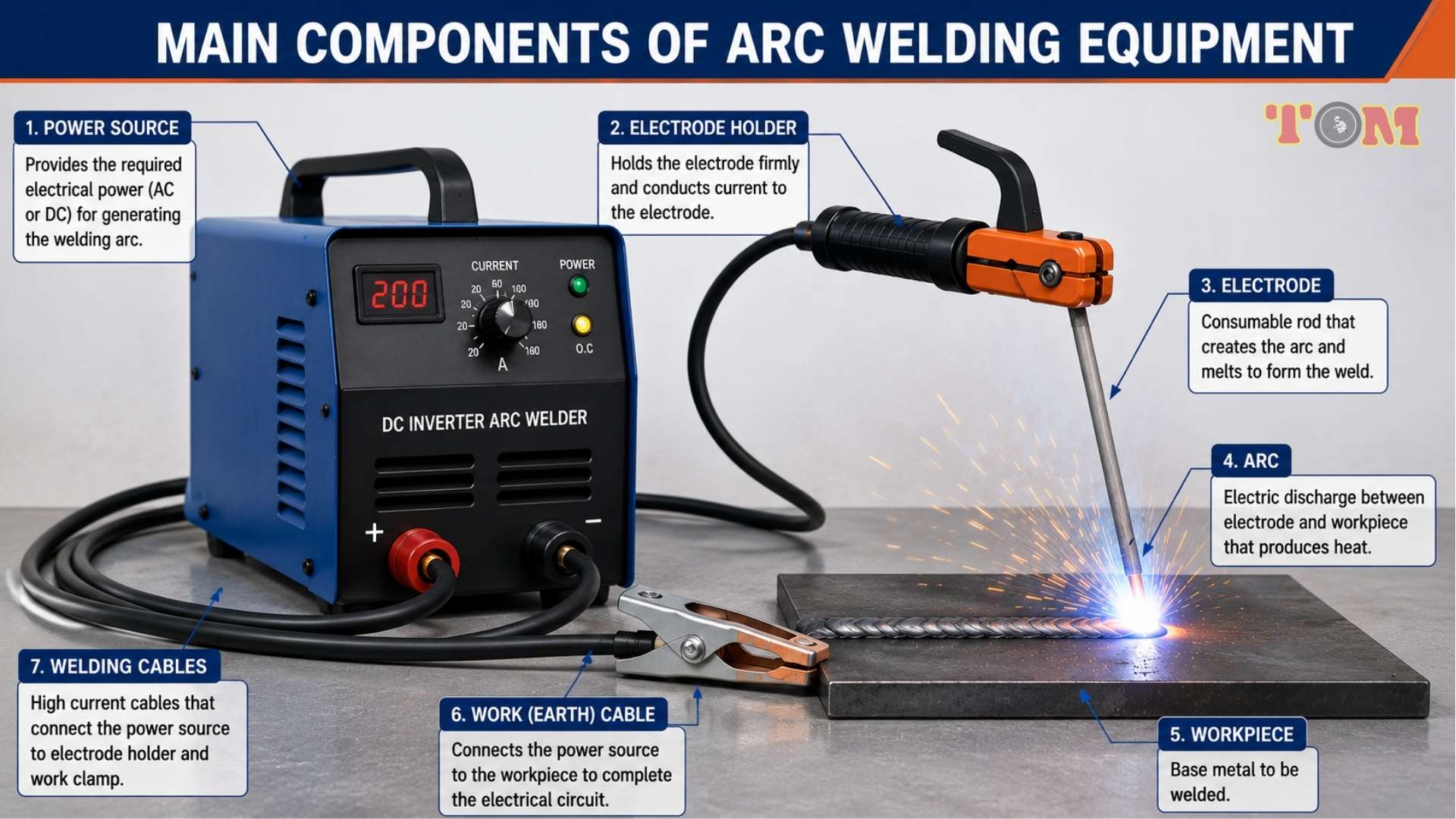
Main Components of Arc Welding Equipment
To perform arc welding efficiently, several essential components are required.
1. Power Source
The power source supplies electrical energy to create the arc.
Two commonly used power supplies are:
Constant Current (CC): Used in Stick welding and TIG welding.
The holder grips the electrode and helps the welder control movement.
In MIG and FCAW welding, the welding gun also delivers shielding gas.
4. Shielding Gas Supply
Processes such as TIG and MIG welding use shielding gases to protect the weld pool.
Common gases include:
Argon
Helium
Carbon dioxide
Mixed gas combinations
5. Welding Cables
Welding cables connect the machine to the electrode holder and workpiece, completing the electrical circuit.
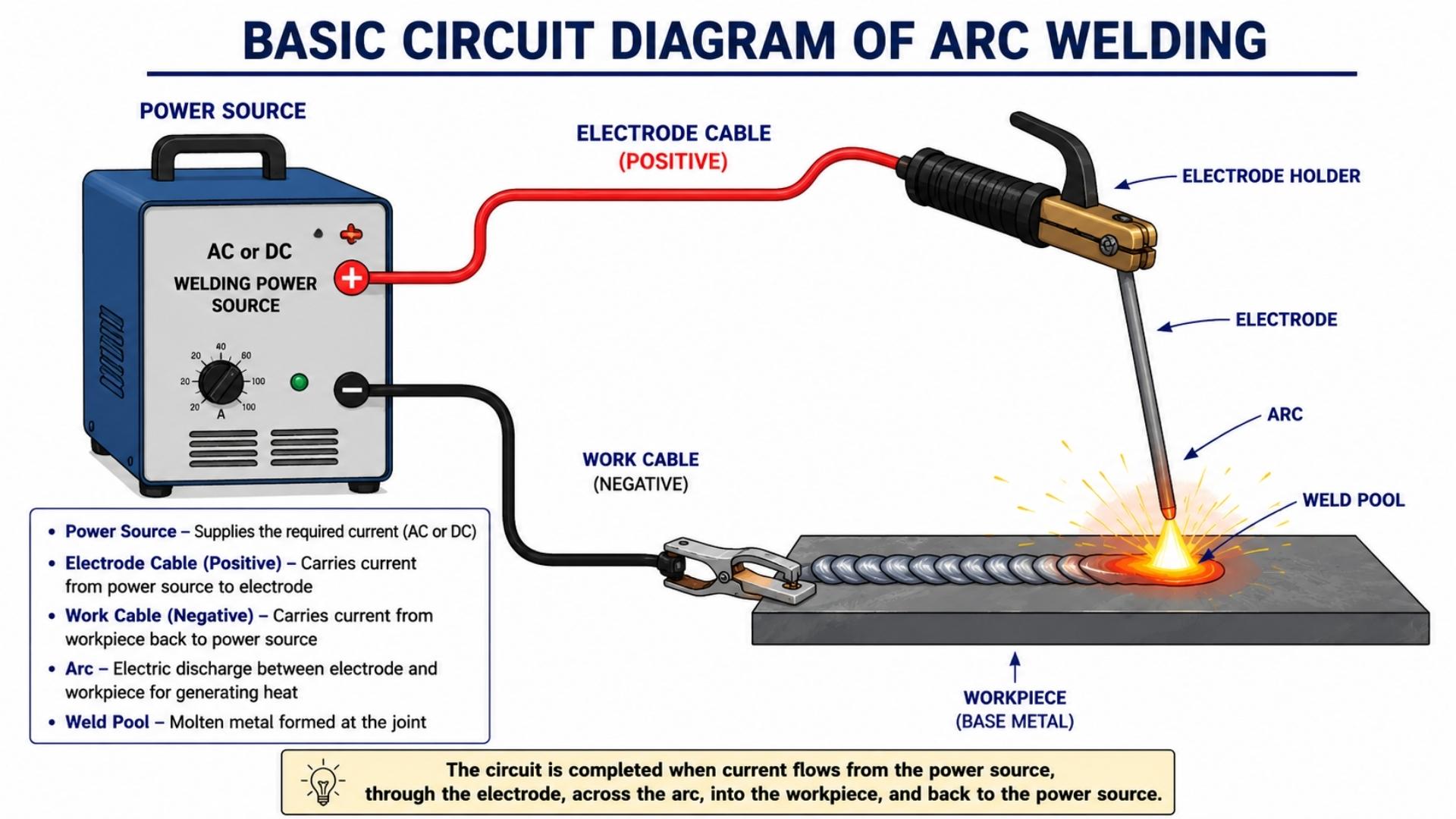
Basic Circuit Diagram of Arc Welding
The basic arc welding circuit consists of:
Power source
Electrode holder
Electrode
Workpiece
Ground clamp
Welding cables
Electric current flows from the power source through the electrode, creating an arc between the electrode and metal surface. The current then returns through the grounding cable, completing the circuit.
How Does Arc Welding Work?
Arc welding follows a step-by-step process to ensure proper metal joining.
Step 1: Preparation
Before welding begins:
Wear protective gear
Clean the work surface
Ensure proper ventilation
Inspect welding equipment
Step 2: Selecting the Electrode
Choose the correct electrode based on:
Material type
Thickness
Welding position
Required strength
Step 3: Setting Up the Machine
The welder adjusts:
Current
Voltage
Electrode polarity
Gas flow rate (if needed)
Step 4: Positioning the Workpiece
The metal is secured to avoid movement during welding. A grounding clamp is attached to complete the circuit.
Step 5: Striking the Arc
The arc is initiated differently based on the welding process:
Stick Welding: Electrode touches the surface briefly.
MIG Welding: Pulling the trigger starts the arc.
TIG Welding: A foot pedal or control switch initiates the arc.
Step 6: Forming the Weld Pool
Heat generated by the arc melts the metal and creates a molten pool.
The welder controls:
Arc length
Travel speed
Electrode angle
Step 7: Adding Filler Material
In TIG welding, filler rods are manually added.
In MIG and Stick welding, the electrode itself acts as filler material.
Step 8: Completing the Weld
Once welding is complete:
The arc is stopped
The weld cools naturally
Slag is removed if required
The weld is inspected for defects
Types of Arc Welding
Different arc welding methods are used depending on material, thickness, and application.
1. Shielded Metal Arc Welding (SMAW)
Also called Stick Welding, SMAW uses a consumable flux-coated electrode to create the weld. During welding, the flux coating melts and produces shielding gas, which protects the molten weld pool from contamination. It is one of the simplest and most commonly used welding methods due to its versatility and ease of use.
Features:
Portable
Cost-effective
Suitable for outdoor work
Applications:
Construction
Repair work
Maintenance
2. Gas Metal Arc Welding (GMAW)
Also known as MIG Welding, GMAW uses a continuously fed wire electrode along with a shielding gas to protect the weld pool from contamination. It is widely preferred for its speed, ease of operation, and ability to produce clean welds with minimal slag.
Features:
Faster welding speed
Easy automation
High productivity
Applications:
Automotive manufacturing
Sheet metal fabrication
Industrial production
3. Gas Tungsten Arc Welding (GTAW)
Commonly called TIG Welding, GTAW uses a non-consumable tungsten electrode and an inert shielding gas, usually argon, to create precise welds. This process is known for producing high-quality, clean, and visually appealing welds, especially on thin materials.
Features:
High precision
Clean welds
Excellent finish
Applications:
Aerospace
Stainless steel fabrication
Pipe welding
4. Flux-Cored Arc Welding (FCAW)
FCAW uses a tubular wire electrode filled with flux to shield the weld during the process. It is highly efficient for welding thicker materials and performs well in outdoor environments, even under windy conditions.
Features:
High deposition rate
Effective for thick materials
Suitable for outdoor conditions
Applications:
Shipbuilding
Heavy fabrication
Structural steel work
5. Submerged Arc Welding (SAW)
In Submerged Arc Welding (SAW), the welding arc is covered beneath a layer of granular flux, which protects the weld from contamination and reduces spatter. This process is ideal for large-scale industrial welding due to its deep penetration and high welding speed.
Features:
Minimal spatter
Deep penetration
High welding speed
Applications:
Pressure vessels
Heavy machinery
Large pipelines
Applications of Arc Welding
Arc welding is widely used across industries due to its reliability and versatility.
Construction Industry: Used for steel structures, bridges, and reinforcement bars.
Automotive Industry: Applied to vehicle chassis, exhaust systems, and body panels.
Aerospace Industry: Used for precision welding of aircraft structures and engine parts.
Manufacturing Industry: Helps fabricate machines, industrial tools, and equipment frames.
Shipbuilding Industry: Essential for ship hull fabrication, offshore platforms, and Marine repairs.
Advantages of Arc Welding
Arc welding offers several important benefits.
High Versatility: Can weld multiple metals and alloys, making it suitable for a wide range of industrial and repair applications.
Strong Welded Joints: Produces durable and reliable welds that are ideal for structural and heavy-duty applications.
Cost-Effective: Uses relatively affordable equipment and consumables, making it economical for many welding tasks.
Portable Equipment: Especially useful for fieldwork and remote locations due to the portability of certain welding setups like stick welding.
Faster Welding Speed: Processes such as MIG and FCAW improve productivity by allowing faster metal deposition.
Suitable for Different Positions: Can be performed in flat, vertical, horizontal, and overhead positions, making it highly adaptable for various job requirements.
Disadvantages of Arc Welding
Despite its benefits, arc welding also has some limitations.
Requires Skilled Operators: Arc welding demands proper training and experience, as poor technique can result in weak or defective welds.
Safety Hazards: Involves risks such as burns, electric shock, harmful fumes, and exposure to ultraviolet radiation, making proper protective equipment essential.
Heat Distortion: High welding temperatures can cause thin materials to warp or distort during the welding process.
Post-Weld Cleaning: Some processes, such as SMAW (Stick Welding), require slag removal and surface cleaning after welding.
Limited to Conductive Materials: Arc welding can only be used on conductive materials, restricting its application with non-metals and composites.
Energy Consumption: Industrial-scale arc welding can consume significant electricity, increasing operational costs.
Safety Precautions in Arc Welding
Safety is critical during arc welding due to high heat and electrical hazards.
Ensure Proper Ventilation: Adequate airflow in the workspace helps prevent inhalation of harmful fumes and gases generated during welding.
Prevent Fire Hazards: Keep flammable materials away from the welding area and maintain a safe workspace to minimize fire risks.
Follow Electrical Safety: Use insulated equipment, ensure proper grounding, and regularly inspect cables to prevent electric shock hazards.
Get Proper Training: Well-trained welders can perform safer, more efficient, and higher-quality welds while minimizing defects and accidents.
Common Defects in Arc Welding
Poor welding technique may cause defects such as:
Porosity: Small holes may form in the weld due to trapped gases, which can weaken the strength and quality of the joint.
Cracks: Thermal stress during heating and cooling can cause cracks to develop in or around the welded area.
Slag Inclusion: Occurs when slag becomes trapped inside the weld metal, reducing weld strength and overall quality.
Lack of Fusion: Improper bonding between the base metals or filler material can result in weak and incomplete welds.
Spatter: Small droplets of molten metal may scatter around the welding area, affecting appearance and requiring cleanup.
Proper Technique and Setup: Maintaining correct welding parameters, electrode selection, and proper technique helps minimize these common welding defects.
Factors Affecting Arc Welding Quality
Several factors influence the quality, strength, and appearance of an arc weld. Proper control of these parameters helps ensure stronger, cleaner, and defect-free welds.
Current Setting: The welding current determines the amount of heat generated during the process. Too much current may burn through the material, while too little can result in poor penetration.
Voltage: Voltage affects the stability and length of the arc. Proper voltage settings help produce a smooth weld bead and consistent welding performance.
Electrode Type: Selecting the correct electrode based on the material and application is important for achieving strong welds and minimizing defects.
Travel Speed: The speed at which the welder moves the electrode impacts weld penetration and bead shape. Incorrect travel speed can lead to weak joints or excessive buildup.
Arc Length: Maintaining an appropriate distance between the electrode and the workpiece ensures stable arc formation and proper metal fusion.
Material Thickness: Thicker materials generally require higher heat input and suitable welding parameters to achieve sufficient penetration and weld strength.
Joint Preparation: Proper cleaning and preparation of the joint remove dirt, rust, oil, and contaminants, helping create stronger and cleaner welds.
Controlling these parameters properly ensures better weld quality, improved durability, and reduced welding defects.
Arc Welding vs Gas Welding
Feature
Arc Welding
Gas Welding
Heat Source
Electric arc
Fuel gas flame
Temperature
Very high
Comparatively lower
Speed
Faster
Slower
Precision
High
Moderate
Applications
Heavy fabrication
Light repair work
Conclusion
Arc welding is one of the most important and widely used metal joining techniques in modern engineering and manufacturing. Its ability to create strong, durable, and reliable welds makes it essential across industries such as construction, automotive, aerospace, and heavy fabrication. Understanding its working principle, equipment, types, applications, advantages, and safety measures helps in selecting the right welding process for different tasks. Whether you are a beginner exploring welding or an experienced professional, mastering arc welding can significantly improve fabrication quality and efficiency while ensuring safer and stronger metal joints.