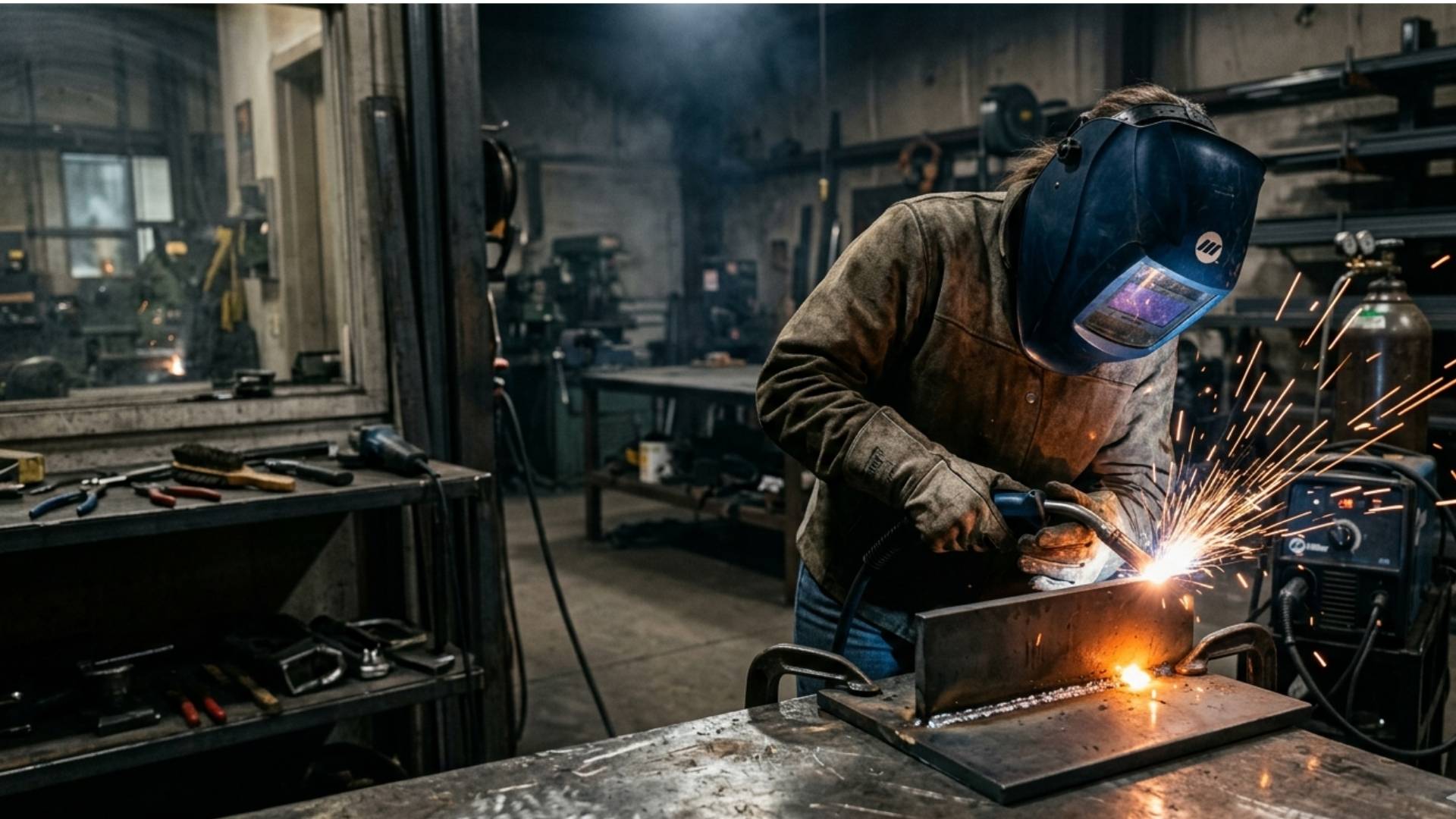
Welding is not extremely hard to learn, but it does require practice, patience, and proper technique. Most beginners can learn the basics within a few weeks, but becoming highly skilled can take months or years of experience.
The difficulty mainly depends on the type of welding, equipment used, and the learner’s dedication.
Let’s break down the honest truth.
The Basic Skills of Welding Are Easy to Learn
For most beginners, the first step is learning how to:
Hold the welding torch correctly
Maintain the correct arc length
Move the torch steadily
Control heat and speed
Many beginners start with MIG welding, which is considered the easiest process.
Why MIG welding is beginner-friendly
Automatic wire feeding
Stable arc
Less skill required than other methods
Easier to control puddle
Many people can produce their first acceptable weld bead within a few hours of practice.
The Real Challenge Is Controlling the Weld Pool
The hardest part for beginners is learning to control the weld puddle.
The weld puddle is the molten metal pool created during welding. You must control:
Travel speed
Heat input
Torch angle
Arc distance
If any of these are wrong, you may get Welding defects like:
Porosity
Undercut
Lack of penetration
Weak welds
This skill improves only with consistent practice.
Different Welding Types Have Different Difficulty Levels
Welding Process
Difficulty
Why
MIG (GMAW)
Easy
Automatic wire feed, stable arc
Stick (SMAW)
Medium
Harder arc control
TIG (GTAW)
Hard
Requires both hands and foot pedal
Flux-Cored
Easy–Medium
Similar to MIG but more spatter
TIG weldingis usually the hardest because you must control:
Torch
Filler rod
Foot pedal
This requires excellent coordination.
Safety and Setup Take Time to Learn
Welding isn’t just about joining metal.
You must also learn:
Proper helmet and PPE use
Metal preparation
Machine settings (voltage & wire speed)
Ventilation and fire safety
Safety knowledge is essential because welding involves:
Extreme heat
UV radiation
Sparks and fumes
How Long It Takes to Learn Welding
Skill Level
Typical Time
Basic weld bead
1–2 days
Decent beginner welds
1–2 weeks
Job-ready welding
3–6 months
Expert welder
Several years
Many trade schools train welders in 6–12 month programs.
Common Mistakes Beginners Make
New welders often struggle with:
Moving the torch too fast
Wrong voltage settings
Poor joint preparation
Incorrect torch angle
Not watching the weld puddle
These mistakes are normal and improve quickly with practice.
The Truth: Welding Is Skill-Based, Not Talent-Based
The honest truth is:
Anyone can learn welding with enough practice.
You don’t need to be:
Naturally talented
Extremely strong
Highly technical
You only need:
Patience
Practice time
Good instruction
Many professional welders started with zero experience.
Simple Rule:
Welding is easy to start but takes time to master.
Welding is moderately easy to learn for beginners, especially with MIG welding. However, mastering high-quality welds and advanced techniques requires consistent practice and experience.
If you’re willing to practice regularly, welding becomes one of the most rewarding hands-on skills you can learn.